Tracing the spread of Celtic languages using ancient genomics
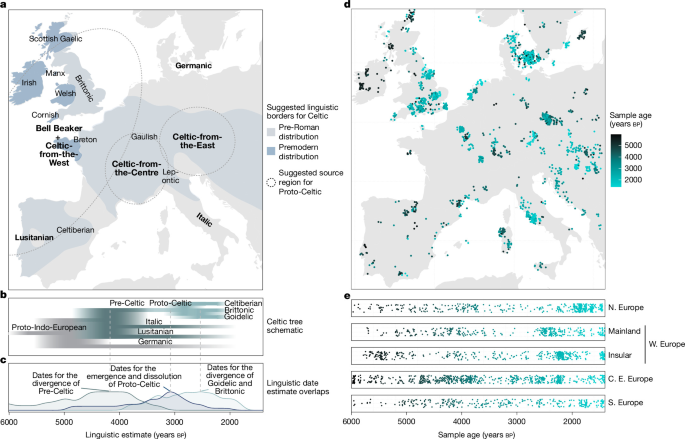
Celtic languages are today restricted to Europe’s Atlantic fringes but were widely spoken across the continent during the Iron Age1–3. How Celtic achieved this early distribution remains contested4, with alternative archaeological and linguistic models proposing different homelands and dispersal routes. Here we analyse genome-wide data from 4,587 ancient individuals, focusing on Bronze and Iron Age Europe, to test the extent to which these models fit reconstructed demographic histories. We identify three main processes shaping European population structure that are relevant to the Celtic dispersal. First, the arrival of Steppe-related ancestry with Bell Beaker-associated groups after around 4400 bp (calibrated years before present or 1950 ce) across the region in which Celtic and related languages were later spoken. Second, a movement from southwestern Europe into Britain during the Bronze Age (3800–3200 bp), consistent with scenarios in which Celtic formed along the Atlantic façade. Third, a westward expansion of ancestry related to Late Bronze Age Knovíz–Urnfield-associated populations from eastern central Europe (3200–2800 bp), affecting France, the British Isles, northeastern Iberia and Italy and later associated with Iron Age Hallstatt and La Tène contexts5–8. Although all three movements have parallels with proposed models, we argue that the final movement, from eastern central Europe, is most parsimonious for the spread of Celtic. Although human history does not necessarily follow a parsimonious trajectory9 and language shifts need not track genetic change, these results delimit the demographic scenarios that are plausible for the emergence of Celtic in prehistoric Europe. Genome-wide data from 4,587 ancient individuals are analysed, focusing on Bronze and Iron Age Europe, to test the extent to which alternative archaeological and linguistic models for the origin and spread of Celtic fit reconstructed demographic histories.


